Where Engineering Meets Art
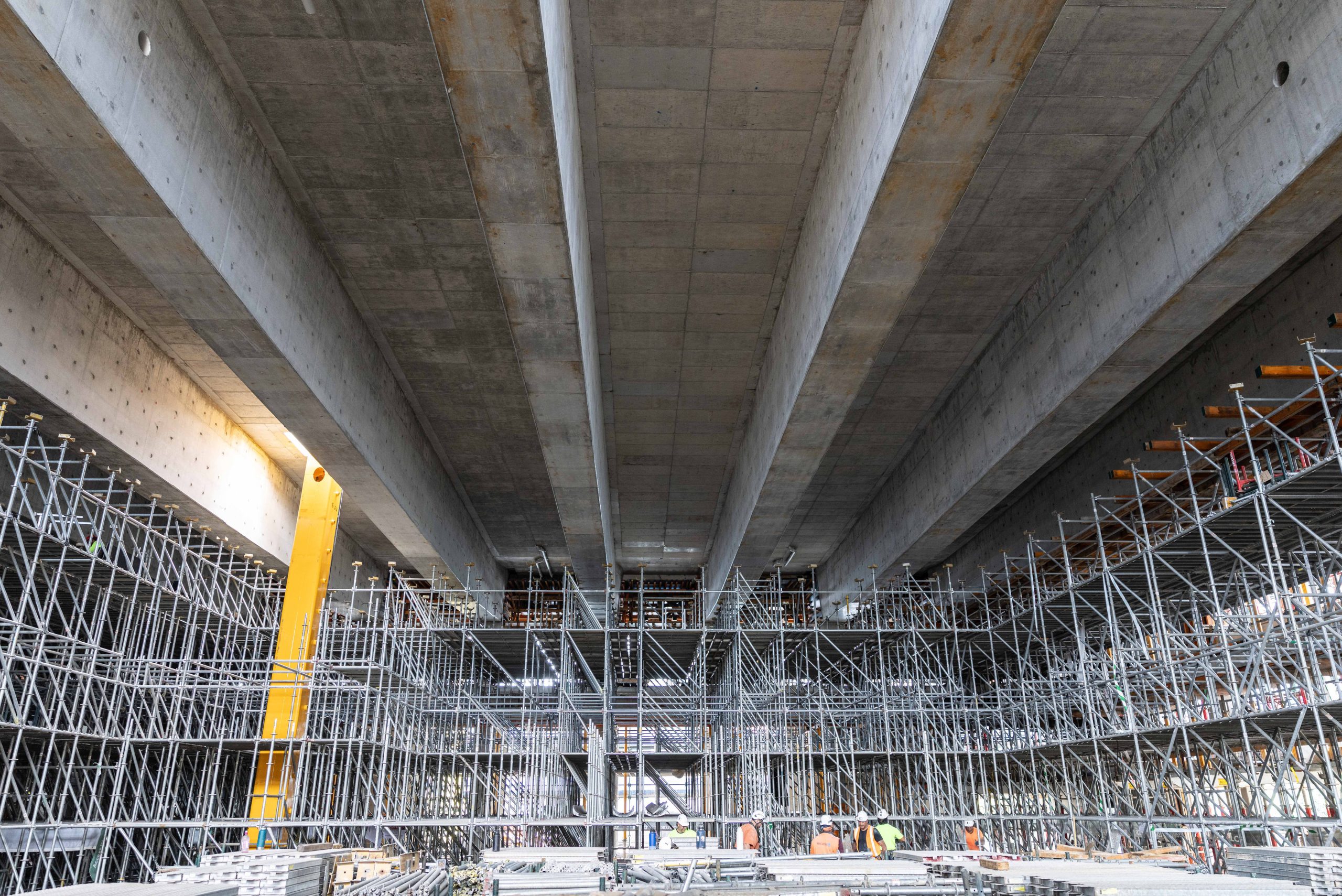
What sets these beams apart is both their scale and geometry. While typical commercial concrete beams have a 1:1 width‑to‑depth ratio, this project has pushed engineering boundaries with a ratio close to 1:3, measuring 1000mm wide and peaking at 2709mm deep in the main spans.
Each beam also features 4 metre long tapered cantilevered ends, transitioning from a rectangular profile into a precisely formed trapezoidal shape (approx. 940mm deep × 1340mm wide). These tapering sections carry significant loads while upholding the architectural vision of completely unobstructed courts below.
Inside every tapered beam end lies a highly intricate steel structure –
- 31 uniquely sized trapezoidal stirrups
- 127 individually shaped reinforcement bars
- All arranged in exact positions to maintain structural performance
To ensure adequate reinforcement coverage, pinpoint cog location and avoid clashes when tightening threaded bars, Taylor Thompson Whitting created a full 3D reinforcement model, validating the geometry of all 262 individual bars within each column to beam interface.
The two supporting columns posed their own challenge, rising from pile caps at foundation level and transitioning from oval to large rectangular profiles before integrating precisely into the beams above. Each reinforcement bar in these sections had only one correct position, demanding total accuracy.
This is engineering many will never see, but it is what makes the building stand.
Constructed With Precision Onsite
- Every beam was constructed insitu, a complex process beginning in the foundations
- 130 sacrificial concrete piles were installed below the ground floor slab to support the weight of the formwork scaffold system and wet concrete during pouring.
- The bird‑cage scaffold system created a temporary load path and working platform.
- Formworkers built the underside of each beam before erecting vertical formwork.
- Steel fixers then installed the complex reinforcement cages one beam at a time.
- The beams incorporate three multistrand post-tensioning tendons, each consisting of 19 x 12.7 mm strands stressed at the live end using a 600 kg multistrand stressing jack. Each strand is tensioned to approximately 9 tonnes of force (≈90 kN) to achieve the required design prestress levels.
- The stressing operation produces an elongation of approximately 7.1 mm per metre, resulting in a total extension of around 270–280 mm across the full tendon length.
- The slab soffit was constructed, and tie bars were installed to counteract the powerful lateral pressure of wet concrete.
- Concrete was placed in layers using a Putzmeister tower boom, with all formwork materials and reinforcement lifted into position by the 25‑tonne luffing tower crane.
- Concrete was monitored with real-time sensors inserted into each pour to measure temperature to offset thermal cracking.
The first beam took the longest as the team refined processes, but ultimately each beam required approximately four weeks – a testament to the craftsmanship and coordination involved.
The Weight of Achievement
The completed beam structure contains:
- 115m³ of concrete, weighing 276 tonnes (the equivalent of 17.25 buses or 55.2 adult male elephants)
- 75 tonnes of steel reinforcement
- 3 tonnes of post‑tensioning cables
These numbers reflect not just scale, but the remarkable integration of design, engineering, logistics, onsite execution, and digital modelling required to bring the beams to life.